Tripi-trapu
Kirmen Uribe · Basque Country
As animals disappear, their names disappear, too. First nature, then memory. Ugarixu was one of the words for frog in my hometown, Ondarroa. It comes from the verb uger, meaning to swim. What a beautiful way to define an animal: not by what it is, but by what it does best. The swimmer becomes the frog.
Frogs are now in danger in the Basque Country. The weather is drier and there are fewer ponds, because we are obsessed with building everywhere, covering the land with concrete. Frogs used to live in a place called Urepel, “the place of warm waters.” They liked to swim there. There were other places, too. We knew them all. We loved them most when they were zapaburu—tadpoles, heads of toads.
We are children. My best friend and I. Franco has just died. We are at the fiestas of a small village in the hills—just a church and a few farmhouses. Someone shows the forbidden Basque flag. The police arrive. Our parents are frightened. They can’t find us. We are at a pond, watching the zapaburu. When our parents finally arrive, the tadpoles disappear, like people hiding from the police.
There is another word for frog in Ondarroa. Ugarixu comes from swimming. This one comes from sound, from the way they sing: tripi-trapu. It is an onomatopoeia, and also a kind of magic. Tripi-trapu: pure music, pure imagination.
The weather is drier and there are fewer ponds, because we are obsessed with building everywhere, covering the land with concrete.
Some years later, with the same friend, in late June, we go to another fiesta on another hill. Again, a church and a few houses. There is a rock concert. We hitchhike there, then walk up through the forest.
I don’t remember the band. But I remember the frogs when we walk back down at sunrise. The road runs along a river. Hundreds of frogs are singing all at once. My friend and I stand there. It feels like a gift.
A car stops and asks if we want a ride to Ondarroa. We get in, and everything vanishes.
The frogs vanish. The word ugarixu disappears. My friend dies. But all those things—the zapaburu, the forbidden flag, our anxious parents, Urepel, my beloved friend—live on and come back to me from time to time, from somewhere far away, like the sound of hundreds of frogs deep in the river: tripi-trapu, tripi-trapu.
About the author
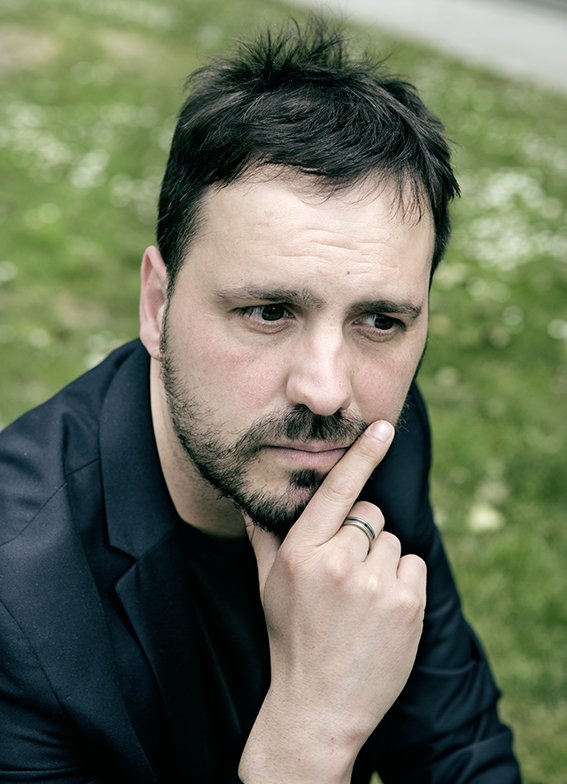
Kirmen Uribe is a Basque-born, New York–based writer. His debut novel, Bilbao–New York–Bilbao (Coffee House Press, 2023), received Spain’s National Prize for Literature. His work has appeared in The New Yorker, The Paris Review, and other major literary journals. A former NYPL Cullman Center Fellow, he serves as Writer in Residence at New York University. His new novel, Life Before Dolphins, translated by Megan McDowell, is forthcoming from Coffee House Press in January 2027.