Analog
Emily Strasser · Florida
As in the clocks my grandfather collected in his South Florida home: a clock powered by a potato stuck with wires; a cat clock that rolled its eyes and flicked its tail in time to the seconds; a clock with hands that moved counterclockwise around a reversed face.
Analog technology translates natural forces into information—the grooves on a record, mercury in a thermometer, the needle on a speedometer. Before pendulums turning gears, there was the flow of water from vessel to vessel or the gnomon of a sundial shading the hour.
Digital technology abstracts the moving and physical world into discrete, countable units. In Union Square in New York City, a giant digital Climate Clock counts down the time we have left before we burn the planet’s remaining “carbon budget” and surpass 1.5 degrees of warming.
Humans have kept time in various ways for millennia. But the standardization of clock time fueled Western imperialism by improving navigation, regulating labor, and replacing local, seasonal rhythms with hours that were the same everywhere.
A clock is both a tool and a weapon.
If the clock severed time and place, can we re-member them?
Each hour in my grandparents’ house was greeted by a raucous chorus: the dignified chiming of the grandfather clock colliding with the chug-chugging of a train circling a tiny rail, giving way to the rapid chirp of a house wren on the Audubon clock. Pop collected timepieces not for love of efficiency, but for whimsy. His favorite, maybe, was a watch with a button on the side that made a rooster crow, which he pushed at least once during a church service.
Outside, Pop tended a garden lush with begonias, oleander, and hibiscus in many colors. After they moved into a retirement community, he and my grandmother would prune the roses, cutting fresh blooms for every person’s birthday, hand-delivering each long-stemmed blossom with a song.
They lost friends every week, the names of those who passed posted on a bulletin board in the common room.
We never talked about climate change. But with the blaring of Fox News filling more and more of his hours, I imagine he did not believe in it.
His favorite, maybe, was a watch with a button on the side that made a rooster crow, which he pushed at least once during a church service.
Another meaning of “analog” is a thing that is like another thing, an approximation or stand-in. In rewilding, conservationists may introduce an analog species to replace an extinct keystone megafauna. Now there are robots that can cut roses, and researchers are trying to use AI to digitize smell.
When the internet is fully populated by bot-fabricated news, our emails replaced by correspondence between digital analogs of ourselves, perhaps the only way to know a thing will be to sit knee to knee, to tell each other stories of our bodies in place.
An analog exists only in comparison, only in relation. As do we, as does everything.
Analog for clock is a retronym, meaning it was named so only after the dominance of the digital clock. Analog names the before-times, but also what is still with us, still possible.
Whether it’s a good idea to use an analog species to recreate an environment of the distant past is a complicated question. But to go analog feels sneaky in its simplicity, like dodging a punch with a shrug. I turn my phone off. I mend a tear in my jeans. I have my students write on paper. I send them outside with no devices or instructions. Some are bored. Some are anxious. Some talk to each other.
An analog clock is an abstraction of a sundial, which tracks the actual arc of sun across sky. Let the clock’s hands become our own, raised in praise to proclaim, here we stand on this bit of planet, faces warmed by this star just so.
I missed my chance to tell Pop that chasing blue-tailed lizards in his garden and holding fairy weddings beneath the bougainvillea fed my wonder for all kinds of life. That picking oranges taught me that juice that tastes like sunshine comes from trees.
On his deathbed, Pop was confused about the time, insisted it was night when it was morning, told my mother to bring cookies for the invisible people who had been hanging around all day. He led the room in a round of “Happy Birthday.” He’d sung to so many on their last birthdays.
Stick your nose deep into a rose. Beneath the sweetness is the green of new life and the ripeness of decay, all at once.
About the author
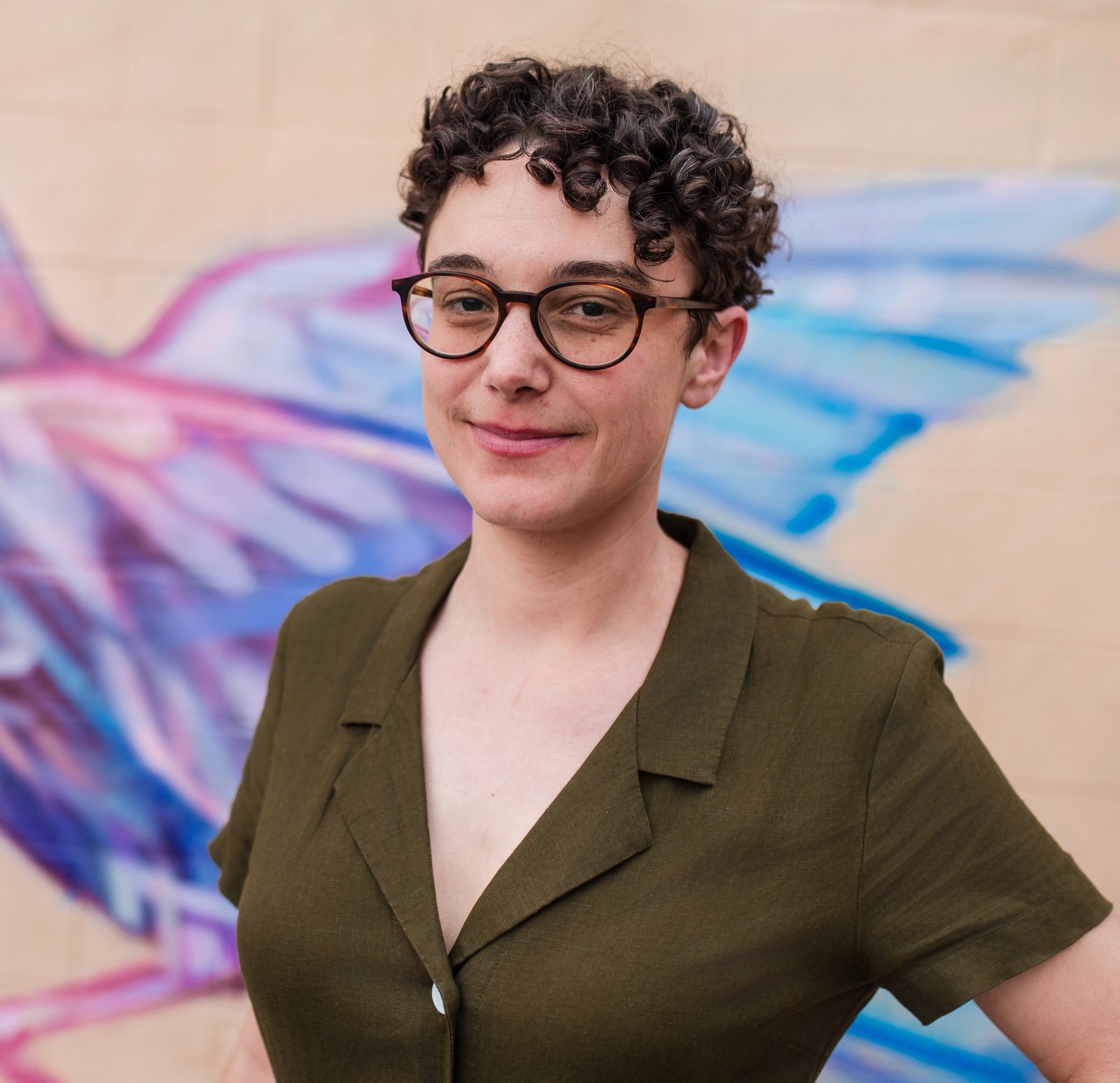
Emily Strasser is a writer based in Boston. Her first book, Half-Life of a Secret, is a deeply researched memoir about the intersection of family and national secrets in the atomic city of Oak Ridge, Tennessee. It was awarded the 2024 Reed Environmental Writing Award, the 2024 Minnesota Book Award, and was a finalist for the Chautauqua Prize. Other writing has appeared in The Guardian, Popular Mechanics, Catapult, Ploughshares, Guernica, Colorado Review, The Bitter Southerner, Bulletin of the Atomic Scientists, and Gulf Coast, among others. Her work has been recognized by grants, awards, and fellowships including the Olive B. O’Connor and McKnight fellowships, and grants from the Minnesota State Arts Board and the Jerome Foundation. She is a Professor of the Practice in Creative Nonfiction and Journalism at Tufts University.